Florida Memorandum and Notice of Agreement
County Specific Legal Forms Validated as recently as October 6, 2026 by our Forms Development Team
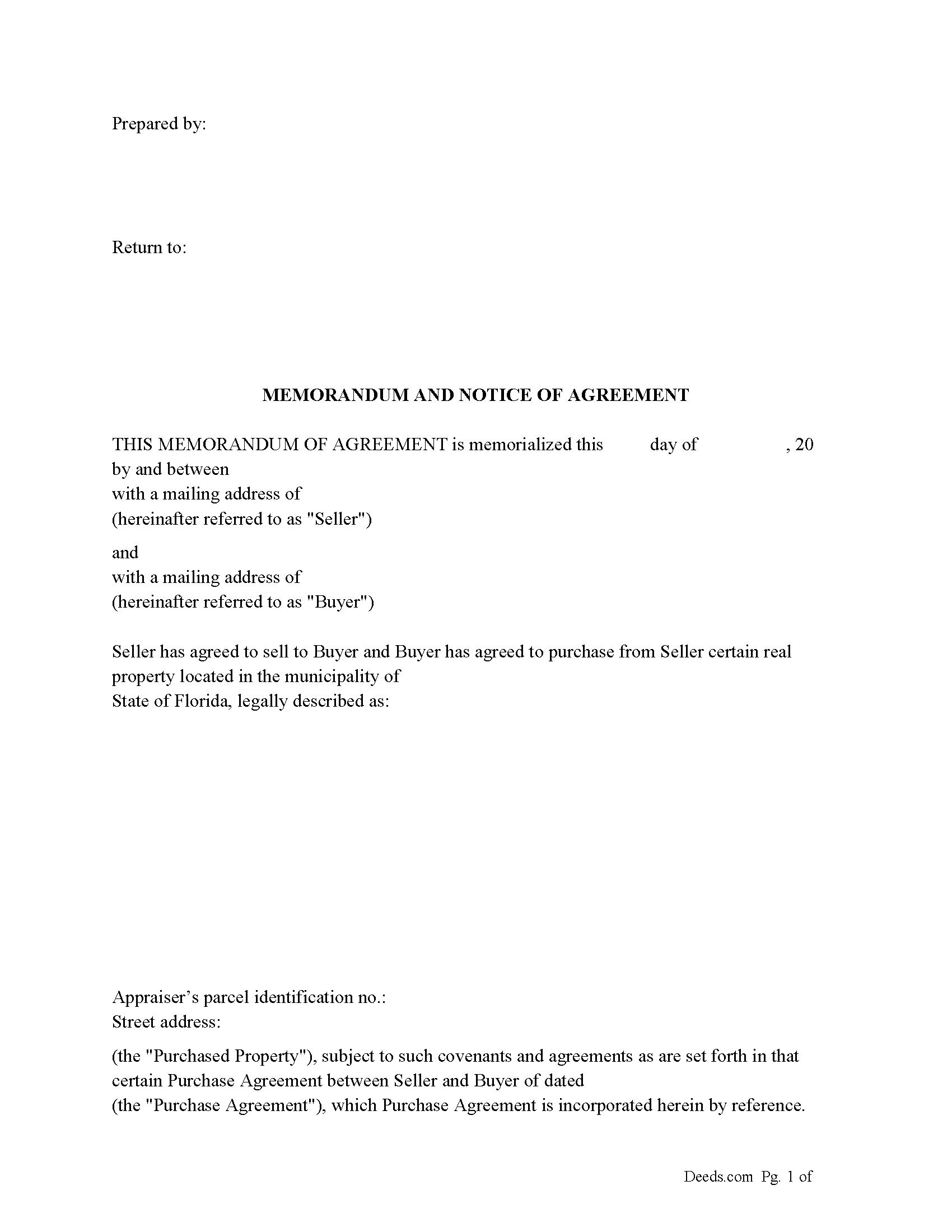
About the Florida Memorandum and Notice of Agreement
How to Use This Form
- Select your county from the list
- Download the county-specific form
- Fill in the required information
- Have the document notarized if required
- Record with your county recorder's office
What Others Like You Are Saying
"Deeds.com made the recording of my timeshare Quit Claim Deed painless and extremely fast. I'm talkin…"
"Excellent Service, Fast and efficient. Thank You!"
"Very pleased with the services provided by deeds.com. Quick response time after information was prov…"
"Excellent Website."
"I called the county clerk office yesterday that i wanted to get a deed e-filed and recorded. I was t…"
4.8/5 from 4,825 reviews. Read all
A Florida Memorandum and Notice of Agreement is used when the parties want the county Official Records to show that a specific agreement affects Florida real property while keeping the full contract terms, pricing details, deadlines, and private contingencies out of the recorded file. Florida's version is different from a generic memorandum because Florida records through the clerk of the circuit court, indexes documents in the county Official Records, and gives priority by official register number, while also imposing Chapter 695 formatting, preparer, address, witness, and acknowledgment requirements that can determine whether the clerk accepts the document.
What the Florida Memorandum and Notice of Agreement Does
People commonly use a Florida Memorandum and Notice of Agreement with a purchase agreement, option agreement, installment land contract, lease-purchase arrangement, or other written agreement that gives a party an equitable or contractual interest in a named parcel before the final deed or other closing document is recorded. The memorandum records the essential notice information, such as the parties, agreement date, property description, and interest being noticed, but it does not transfer legal title and does not replace the underlying agreement. In Florida, recording matters because a conveyance, mortgage, lease for one year or longer, or other real property interest is not effective against creditors or later purchasers for value without notice unless recorded according to law (Fla. Stat. § 695.01).
Florida Recording Rules for Memoranda and Notices of Agreement
Florida clerks of the circuit court serve as county recorders, and recorded real estate instruments are kept in the county Official Records (Fla. Stat. § 28.222). A memorandum or notice of agreement affecting Florida real property should be recorded in the county where the property is located, using the legal description that appears in the prior deed, plat, or other source document.
- Recordable subject matter: Florida authorizes clerks to record agreements, notices, and other instruments relating to ownership, transfer, encumbrance, or claims against real property or an interest in it (Fla. Stat. § 28.222).
- Names and addresses: The name and post-office address of each person signing must be legibly printed, typed, or stamped under that person's signature (Fla. Stat. § 695.26).
- Preparer identification: Florida requires the name and post-office address of the natural person who prepared the instrument, or under whose supervision it was prepared, to appear on the document (Fla. Stat. § 695.26).
- Witness and notary identification: When witness signatures appear, each witness name and address must be printed under the witness signature, and the notary name must be printed, typed, or stamped under the notary signature (Fla. Stat. § 695.26).
- Recording space: Florida requires a 3-inch by 3-inch blank space at the top right corner of the first page and a 1-inch by 3-inch space at the top right corner of each later page for clerk use (Fla. Stat. § 695.26).
- Legal description: A street address or parcel identification number alone is not a substitute for the legal description used for recording. For platted Florida property, the description should track the lot, block, subdivision name, plat book, page, and county from the recorded plat or prior deed.
Signing, Witnesses, and Acknowledgment in Florida
The memorandum is designed for signature by the parties whose agreement is being placed of record, and Florida recording rules require each signing party's name and mailing address to be printed below the signature. To be recorded, an instrument concerning Florida real property must be acknowledged by the executing party, proved by a subscribing witness, or otherwise legalized or authenticated in the manner Florida law allows (Fla. Stat. § 695.03). When an instrument itself creates, grants, transfers, assigns, or releases an estate or interest in Florida land, Florida requires signing in the presence of two subscribing witnesses, which is stricter than the rule in many states (Fla. Stat. § 689.01). Florida's notary certificate should identify the notarial act, date, signer, identification method, notary signature, printed notary name, and seal, and Florida statutory short-form acknowledgments include physical-presence and online-notarization options (Fla. Stat. §§ 117.05, 695.25).
Florida-Specific Traps Before Recording
- Homestead and spouse joinder: A memorandum connected to the sale, mortgage, gift, or other alienation of Florida homestead can create title questions if the married owner's spouse does not join where Florida homestead law requires joinder (Fla. Const. art. X, § 4(c); Fla. Stat. § 689.111).
- Marital status recitals: Florida title review commonly pays close attention to whether an individual owner is married because homestead rights and tenancy by the entirety depend on marital status. Missing or inconsistent marital status language can delay review even when the clerk accepts the document for recording.
- Preparer line omissions: Florida's natural-person preparer requirement is a frequent recording issue because the statute asks for a person, not just a company name or law firm name (Fla. Stat. § 695.26).
- Documentary stamp tax: A notice-only memorandum is different from a deed, but a document that grants, assigns, transfers, conveys, or vests an interest in Florida real property can be subject to documentary stamp tax (Fla. Stat. § 201.02). In all Florida counties except Miami-Dade, the general rate for taxable real property transfer documents is 70 cents per $100 or fraction of consideration; Miami-Dade has a different base rate and may impose a surtax when the statutory single-family residence exception does not apply (Fla. Stat. §§ 201.02, 201.031).
- Payment obligations and security language: A memorandum that includes promissory, mortgage, lien, or other debt-security language can be treated differently from a notice of agreement because Florida taxes written obligations to pay money and recorded mortgages or liens under separate rules (Fla. Stat. § 201.08).
- Residential sale disclosures: The underlying Florida residential sale agreement may require disclosures that are not normally the purpose of a recorded memorandum, including the property tax disclosure, flood disclosure, subsurface rights disclosure when applicable, and known sanitary sewer lateral defect disclosure (Fla. Stat. §§ 689.261, 689.302, 689.29, 689.301).
- Plat references: Florida parcels in subdivisions should be described by the recorded plat reference instead of relying on a tax roll abbreviation, marketing description, or street address. A memorandum with an incomplete or mismatched legal description may be recorded but still fail to give clear notice in a later title search.
- End of the agreement: A recorded memorandum can remain in the Florida Official Records after the underlying agreement expires or is terminated. A later recorded release, cancellation, or other clearing instrument is commonly used to show that the noticed agreement no longer affects the property.
Priority and Effect of Recording in the Florida Official Records
Florida treats an authorized or required instrument as officially recorded when the clerk assigns the consecutive official register number, and the sequence of those numbers determines recording priority (Fla. Stat. § 695.11). This is why the timing of recording can matter in Florida: a delayed memorandum may lose priority to an intervening deed, mortgage, lien, or other recorded instrument. Recording the memorandum gives public notice of the interest described in it, but the memorandum itself does not complete the transfer of title and does not supply terms that were left out of the underlying agreement.
Florida Vesting References in the Notice
If the memorandum identifies multiple purchasers, option holders, or other interest holders, its names and vesting language should match the underlying agreement. Florida does not presume a right of survivorship for most joint ownership; except for estates by the entirety, a conveyance to two or more persons creates a tenancy in common unless the instrument expressly provides for survivorship (Fla. Stat. § 689.15). For married parties, Florida also recognizes tenancy by the entirety concepts, including spouse-to-spouse conveyance rules and conveyances to both spouses (Fla. Stat. § 689.11). Because a memorandum is a notice document rather than the deed of conveyance, its vesting references should avoid adding survivorship, tenancy by the entirety, trust, or entity-capacity language that is not reflected in the agreement being noticed.
Included in Your Download Package
The Deeds.com download package is built for recording a memorandum and notice of agreement affecting Florida real property and includes the materials needed to complete, sign, and prepare the document for county recording.
- County-specific Florida Memorandum and Notice of Agreement form formatted for Florida recording requirements
- Florida signing and recording instructions with witness, notary, preparer, address, and clerk-space guidance
- Completed example showing how the finished memorandum can be assembled
- Legal description guidance for deed-based and platted Florida property descriptions
- Checklist for reviewing party names, agreement date, property identification, acknowledgment, and recording information before submission
Important: County-Specific Forms
Our memorandum and notice of agreement forms are specifically formatted for each of the 67 counties in Florida.
After selecting your county, you'll receive forms that meet all local recording requirements, ensuring your documents will be accepted without delays or rejection fees.