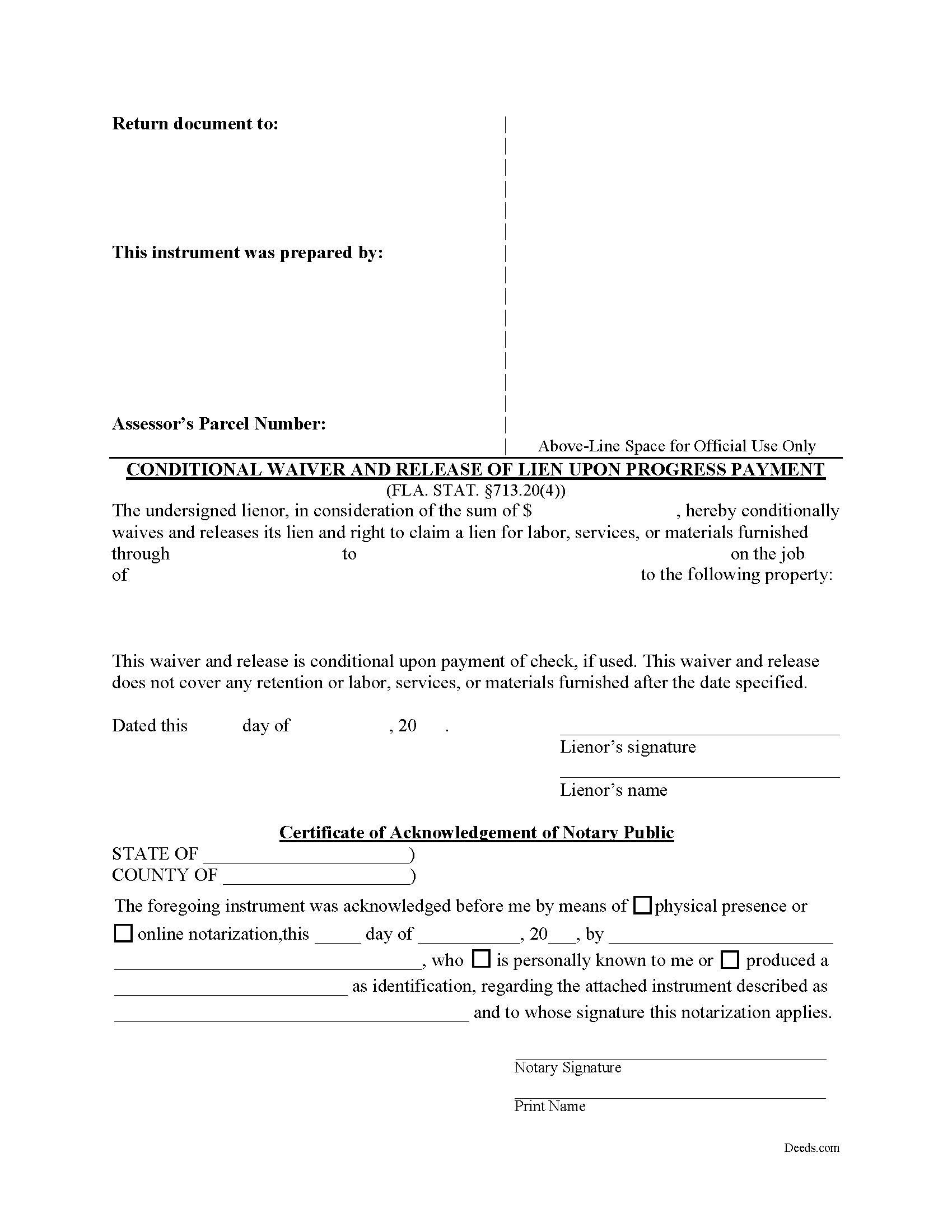
Florida Conditional Waiver and Release of Lien upon Progress Payment
County Specific Legal Forms Validated as recently as September 28, 2026 by our Forms Development Team
About the Florida Conditional Waiver and Release of Lien upon Progress Payment
How to Use This Form
- Select your county from the list
- Download the county-specific form
- Fill in the required information
- Have the document notarized if required
- Record with your county recorder's office
What Others Like You Are Saying
"As i am not very computer ready,i had one heck of a time filling,printing,and copying this document.…"
"This service was extremely helpful. I truly appreciated the way I was communicated with every step o…"
"Great website to get your state and county forms."
"Very quick and painless process!"
"amazingly fast! Thank you!"
4.8/5 from 4,819 reviews. Read all
The Florida Conditional Waiver and Release of Lien upon Progress Payment is the lienor-protective counterpart to the unconditional progress waiver in section 713.20 of the Florida Statutes. With this version, the release is contingent: the lien rights described in the form are released only when the identified progress payment is actually received and clears. If the customer's check bounces, is stopped, or never arrives, the waiver does not take effect and the lienor's lien rights remain intact. Florida codified four statutory waiver scenarios precisely so that lienors and payors can match the right risk allocation to the situation, and the conditional progress waiver is the standard choice when a contractor, subcontractor, or supplier wants to deliver a release simultaneously with the act of being paid without taking on the credit risk of the payment instrument.
What the Florida Conditional Waiver and Release of Lien upon Progress Payment Does
This form is exchanged on a Florida construction project by a lienor — anyone with a right to claim a construction lien under chapter 713 — for a specific interim payment toward labor, services, or materials furnished through a stated date. Calling it "conditional" means the lien release is contingent on actual receipt and clearance of the payment; calling it "progress" means it covers a partial billing during an ongoing job, not the closeout. It is the form most commonly used to accompany a monthly pay application, because it lets the lienor deliver a signed waiver alongside the request for payment without losing the leverage of the underlying lien rights if the funds never land.
Florida Statutory Requirements Under Section 713.20
Florida is one of a handful of states that legislates the wording of construction lien waivers. Section 713.20 sets out specific statutory text for four scenarios — conditional or unconditional, paired with progress or final payment — and instructs that any waiver "substantially follow" the language of the matching statutory form. A waiver that materially deviates from the statutory wording, or that mixes language from a different scenario, may not be treated as a section 713.20 waiver at all. That distinction matters because the statute supplies the conditional language that ties the release to receipt of the payment; rewriting it can quietly convert a conditional waiver into something that operates as an unconditional release, or into a generic contractual document with uncertain effect.
The form must identify the lienor, the customer, the property owner, the amount of the conditional payment, the date through which the waiver applies, and a description of the property — typically the parcel identifier and legal description (§ 713.20).
Execution: No Witnesses, No Notary Required
Statutory waiver forms under section 713.20 do not require witnesses, notarization, or an acknowledgment to be effective. The lienor signs and dates the form, and it is delivered as part of the payment exchange. This is a deliberate departure from the formality required for Florida deeds, which need two witnesses and a notary; lien waivers move with the payment cycle on a job, and the legislature kept the execution requirements light. Some construction lenders and large general contractors require notarized waivers as a matter of internal policy. A notarized waiver is not invalid — the statute simply does not require notarization to make a section 713.20 waiver effective.
Florida-Specific Traps
Several features of the conditional progress waiver routinely surprise out-of-state contractors and owners:
- Advance waivers are void. Florida law prohibits waiving the right to claim a lien before the underlying labor, services, or materials are furnished. A waiver tied to work the lienor has not yet performed is unenforceable to that extent (§ 713.20).
- "Substantially follow" is a real test. A waiver missing a required field, or with the conditional language watered down, may not function as a section 713.20 conditional waiver. The customer who accepts a non-conforming waiver may have to pay twice if the underlying check is dishonored and the lienor's lien rights were never actually released.
- The condition is automatic. The customer does not have a clean release in hand until the payment actually clears. This is the trade-off baked into a conditional waiver — the lienor stays protected, but the payor cannot use the waiver alone as proof that lien exposure has been eliminated for the period covered. Final closeouts and lender funding reviews often demand unconditional waivers for that reason.
- Through date discipline. The form covers work through a stated date. A blank, postdated, or sloppily chosen through date can release more or less than the parties intended and creates evidentiary problems if the project later goes into dispute.
- Notice of Commencement alignment. Florida requires the owner to record a Notice of Commencement on most private projects before construction begins (§ 713.13). The property described in the waiver should match the property described in the Notice of Commencement so that waivers can be tied back to the underlying job.
- Joint check timing. If the progress payment is delivered by joint check, the conditional waiver only takes effect when the lienor is actually paid its share. A signed waiver does not bypass the joint payee's endorsement requirement.
How the Waiver Is Used
The conditional progress waiver is not recorded in the county's official records. It is delivered to the party making the payment — typically the general contractor, owner, or construction lender — and kept with the draw documentation. Because the release is contingent on payment receipt, owners and lenders often track conditional waivers against bank confirmations of cleared funds, and may swap them for unconditional waivers once the check has actually cleared. That two-step approach is common on jobs where the lender insists on documenting unconditional releases for audit purposes.
Download Package
The download package includes the Florida Conditional Waiver and Release of Lien upon Progress Payment, drafted to follow the statutory wording at section 713.20, a completed example showing how each field is filled in, and a guide explaining the form's conditional structure, the statutory framework, and how the four section 713.20 waiver scenarios fit together. The forms are prepared by Deeds.com's forms development team and are delivered as instant downloads.
Important: County-Specific Forms
Our conditional waiver and release of lien upon progress payment forms are specifically formatted for each of the 67 counties in Florida.
After selecting your county, you'll receive forms that meet all local recording requirements, ensuring your documents will be accepted without delays or rejection fees.