Florida Full Release of Memorandum and Notice of Agreement
County Specific Legal Forms Validated as recently as October 20, 2026 by our Forms Development Team
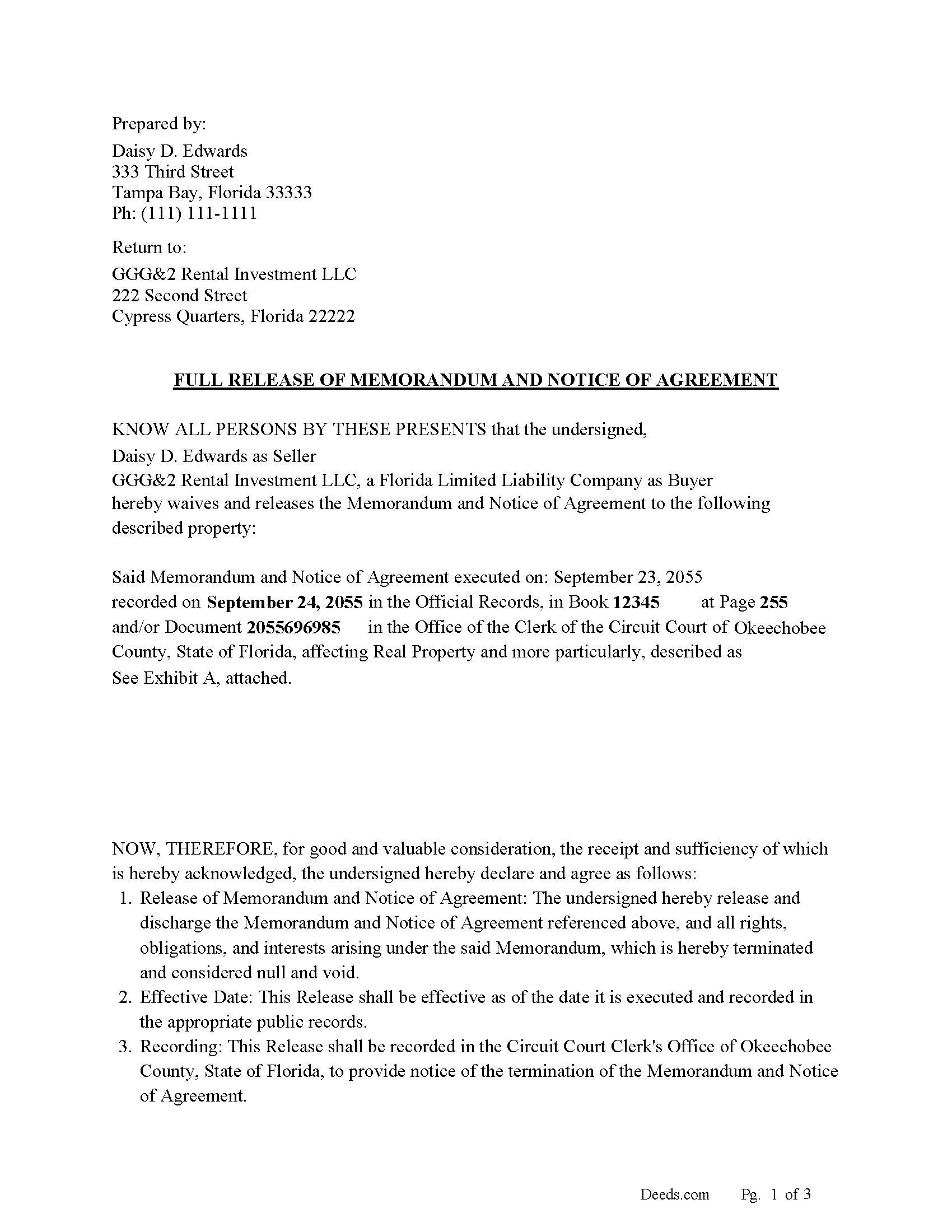
About the Florida Full Release of Memorandum and Notice of Agreement
How to Use This Form
- Select your county from the list
- Download the county-specific form
- Fill in the required information
- Have the document notarized if required
- Record with your county recorder's office
What Others Like You Are Saying
"I ended up loading the same file twice and was unable to delete one of them. I did send e request in…"
"Fast and just as promised"
"Worked very smoothly and got the job done"
"So easy to download and print. Also the examples are very helpful."
"The experience was generally very satisfactory. I was able to fill out the Trust Deed and send it vi…"
4.8/5 from 4,836 reviews. Read all
The Florida Full Release of Memorandum and Notice of Agreement is used after a recorded notice of a purchase agreement or similar real estate contract has placed a buyer’s claimed interest into a Florida county’s Official Records. Florida’s version must do more than state that the contract is over: it needs to identify the original recorded memorandum, release the recorded notice in the county where it appears, and fit Florida’s recording rules for witnesses, notarization, preparer information, printed addresses, and clerk indexing.
What the Florida Full Release of Memorandum and Notice of Agreement Does
A recorded memorandum gives public notice of the existence of a purchase agreement without recording all contract terms. The full release records that the memorandum and notice are canceled, satisfied, terminated, or otherwise no longer claimed as a cloud against the Florida property. It is commonly used after a failed closing, mutual cancellation, expired contract, completed closing where the notice remains in the title chain, or another event that makes the recorded notice inaccurate; the release does not deed the property or replace the purchase contract itself.
Florida Statutory Requirements for a Recordable Release
Florida clerks record agreements, releases, cancellations, and other instruments relating to ownership, transfer, encumbrance, or claims against real property in the county Official Records (Fla. Stat. § 28.222). A full release of a recorded memorandum should connect clearly to the earlier notice by naming the county, the original parties, the recording date, the Official Records book and page or instrument number, and the legal description of the Florida property affected by the release.
Signing, Witnesses, and Notarization in Florida
- Releasing party signature. The party releasing the recorded claim or interest signs the instrument; many Florida releases also include both buyer and seller signatures when the original memorandum was executed by both sides.
- Two witnesses. Florida differs from many states because an instrument that releases an estate or interest in real property is signed in the presence of two subscribing witnesses (Fla. Stat. § 689.01).
- Acknowledgment for recording. To be recorded, the execution of an instrument concerning real property must be acknowledged by the party signing it, proved by a subscribing witness, or otherwise authenticated as allowed by Florida law (Fla. Stat. § 695.03).
- Printed names, addresses, and clerk space. Florida recording rules require the printed, typed, or stamped names and post-office addresses of each signer and witness, the natural-person preparer’s name and address, the notary’s printed name beneath the notary signature, and a 3-inch by 3-inch first-page recording space with a 1-inch by 3-inch space on later pages (Fla. Stat. § 695.26).
- Grantee information where applicable. If the release conveys or purports to convey any interest to a grantee, Florida requires the grantee’s name and post-office address to appear in the instrument (Fla. Stat. § 695.26).
Florida-Specific Title and Recording Traps
- Original recording data. A release that omits the original instrument number, Official Records book and page, or county recording reference may be accepted for recording but fail to make the title connection that a buyer, lender, or title examiner expects.
- Legal description and plat references. For platted Florida property, recorded plats establish the identity of the land and allow conveyance by reference to the plat (Fla. Stat. § 177.021). A lot and block description should carry the subdivision name and plat book and page; a tax parcel number alone is not a substitute for the legal description in the recorded memorandum.
- Homestead and spouse issues. Florida homestead real estate owned by a married person is subject to the constitutional joinder rule for alienation by mortgage, sale, or gift (Fla. Const. art. X, § 4(c)). Because a recorded memorandum often grows out of a sale contract, title review may focus on marital status, spouse joinder, or a non-homestead recital when homestead rights are implicated.
- Marital status recitals. Individual Florida signers are often identified as married or unmarried, or the instrument recites that the property is not homestead, so the release can be matched to the same title facts that controlled the original agreement.
- Survivorship and multiple-party vesting. Florida does not presume right of survivorship for transfers to two or more people, except estates by the entirety; survivorship must be express (Fla. Stat. § 689.15). A release connected to a memorandum signed by spouses, joint tenants, trustees, or entities should mirror the names and capacities used in the recorded notice.
- Documentary stamp tax. Florida documentary stamp tax is tied to instruments that convey real property interests for consideration (Fla. Stat. § 201.02). A release that only clears a recorded notice is not written as a deed transferring title, but tax questions can arise if the instrument includes independent conveyance or consideration language.
- Preparer identification. Florida requires the name and address of the natural person who prepared the instrument or supervised its preparation; a company name alone can create recording problems (Fla. Stat. § 695.26).
Recording the Release in the Florida County Official Records
After signing, the release is recorded with the clerk of the circuit court in the same Florida county where the memorandum and notice were recorded. If the affected property or prior notice appears in more than one county, a release may need to be recorded in each county record where the notice appears. Florida instruments are treated as recorded when the clerk assigns the consecutive official register number, and the sequence of those numbers determines priority of recordation and notice to all persons (Fla. Stat. § 695.11).
Details the Florida Release Connects in the Title Record
The form is built to connect the clearing instrument to the existing Florida Official Records entry. It identifies the buyer, seller, or other original parties; the recorded memorandum and notice; the county recording reference; the property description; and the full release language that removes the recorded notice from the active title chain without relying on the private purchase agreement to explain the release.
What Is Included in the Florida Full Release of Memorandum and Notice of Agreement Download Package
- Florida Full Release of Memorandum and Notice of Agreement form for the selected county
- Instructions prepared by Deeds.com’s forms development team
- Completed example showing how the release is commonly filled out
- Florida recording checklist covering witnesses, notarization, preparer information, printed names and addresses, property description, and Official Records reference
- Supplemental transfer and recording information commonly needed for Florida county recording offices
Important: County-Specific Forms
Our full release of memorandum and notice of agreement forms are specifically formatted for each of the 67 counties in Florida.
After selecting your county, you'll receive forms that meet all local recording requirements, ensuring your documents will be accepted without delays or rejection fees.