Florida Durable Limited Power of Attorney for Real Estate
County Specific Legal Forms Validated as recently as October 5, 2026 by our Forms Development Team
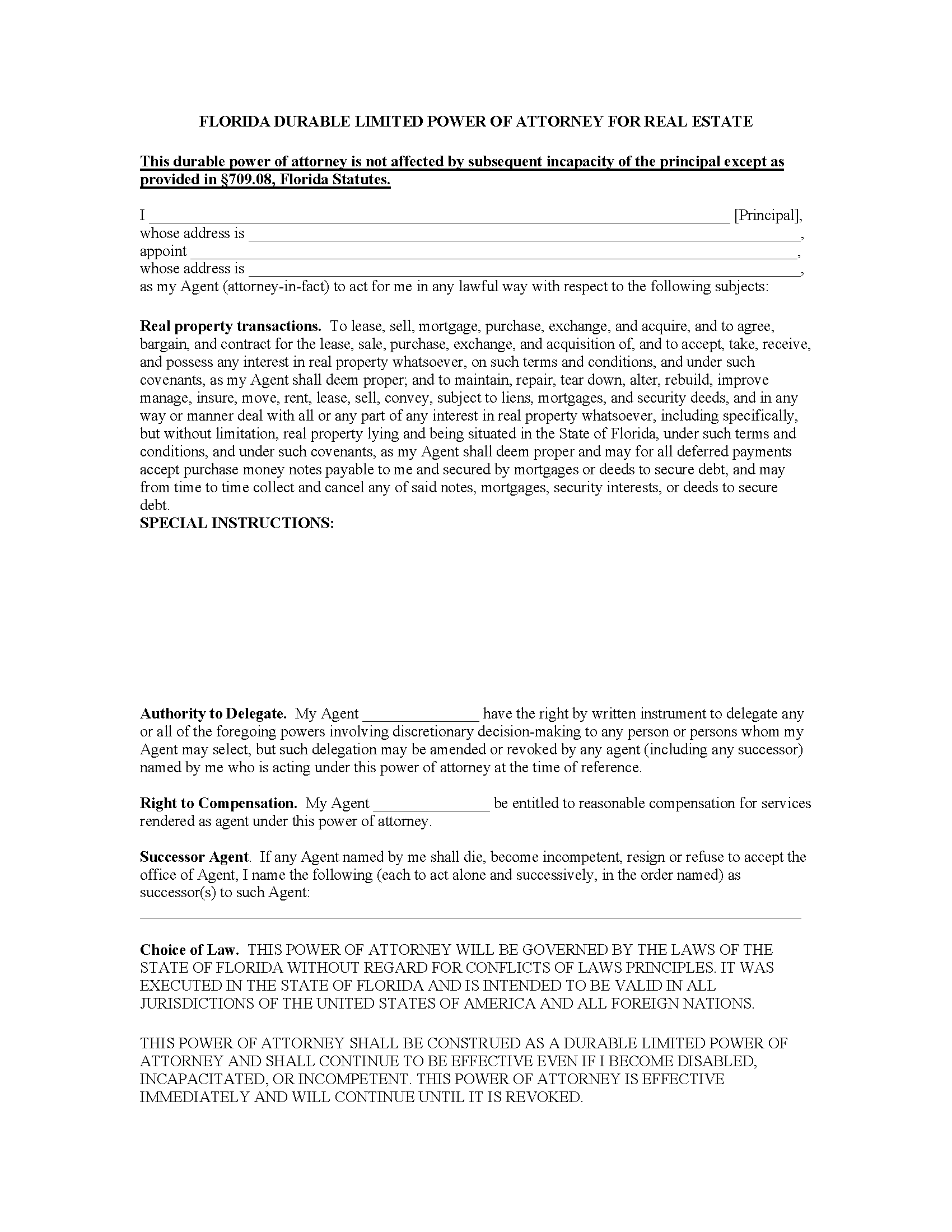
About the Florida Durable Limited Power of Attorney for Real Estate
How to Use This Form
- Select your county from the list
- Download the county-specific form
- Fill in the required information
- Have the document notarized if required
- Record with your county recorder's office
What Others Like You Are Saying
"I really appreciated the detailed instructions provided with the document. The instructions made it …"
"Exactly what I needed and so nice to not have to pay a lawyer"
"I never could even think to solve an important issue involving even overseas individuals without eve…"
"Awesome! I had to correct a quit claim deed and the form on your site made it very easy. Thank you"
"Easily find and print forms necessary for peace of mind."
4.8/5 from 4,821 reviews. Read all
A Florida Durable Limited Power of Attorney for Real Estate is built for Florida real property transactions because Florida does not treat a real estate power of attorney as a casual authorization letter. The principal must give express, specific authority; the document must be signed with two subscribing witnesses and a notarial acknowledgment; and when an agent signs a deed, mortgage, or other real estate instrument, Florida recording law can require the power of attorney itself to be recorded before later creditor or purchaser rights arise. This form lets a property owner name an agent for defined Florida real estate powers while preserving the limited scope of the authorization.
When a Florida Durable Limited Power of Attorney for Real Estate is commonly used
This form is commonly used when a Florida property owner wants an agent to handle a particular real estate matter, such as signing closing documents, conveying or mortgaging real property, satisfying or releasing an interest, managing a transaction while the owner is out of state, or completing a county recording package for a specific Florida parcel. Because it is limited, the form focuses on real estate authority and includes space for specific instructions that can narrow the agent’s powers to the transaction, property, or documents the principal identifies.
Florida statutory authority for a durable limited real estate POA
Florida powers of attorney are governed by the Florida Power of Attorney Act, part II of chapter 709. For real estate use, the most important Florida rules are the rules that make the document durable, immediately effective, specific enough for the agent to act, and acceptable for recording.
- Durability must be stated. A Florida power of attorney is durable only if it contains words showing that the authority continues despite the principal’s later incapacity, such as the statutory durability language or similar wording (Fla. Stat. § 709.2104).
- Florida generally rejects new springing powers. Except for limited statutory exceptions, a Florida power of attorney is exercisable when executed, and a post-2011 power that becomes effective only on a future event or contingency is ineffective (Fla. Stat. § 709.2108).
- Authority must be specific. Florida law provides that an agent may exercise only authority specifically granted in the power of attorney, plus authority reasonably necessary to carry out that express grant. A broad statement allowing the agent to do all acts the principal could do is not enough by itself (Fla. Stat. § 709.2201(1)).
- Real estate powers can include homestead authority. Florida allows a power of attorney to authorize an agent to convey or mortgage homestead property, but a married principal’s spouse must still join in the conveyance or mortgage, either personally or through a properly executed power of attorney (Fla. Stat. § 709.2201(2)(b)).
- Certain powers require separate signed or initialed authority. Creating or changing rights of survivorship, making gifts, changing beneficiary designations, disclaiming property, and other listed acts require the principal’s separate signature or initials next to the specific authority (Fla. Stat. § 709.2202(1)).
Florida execution requirements: witnesses and notarization
A Florida power of attorney must be signed by the principal, signed by two subscribing witnesses, and acknowledged by the principal before a notary public or as otherwise allowed for Florida real property acknowledgments (Fla. Stat. §§ 709.2105(2), 695.03). This is more formal than states that rely only on notarization for many powers of attorney, and it matters for recording because a real estate POA is often examined with the same level of care as the deed or mortgage the agent signs.
The agent must be either a natural person who is at least 18 years old or a qualifying financial institution with trust powers, a Florida place of business, and authority to conduct trust business in Florida (Fla. Stat. § 709.2105(1)). The agent does not have to sign the POA for the document to be created, but Florida law allows third persons to require an agent affidavit before relying on the agent’s authority (Fla. Stat. § 709.2119(2)).
If the principal is physically unable to sign, the notary before whom the oath or acknowledgment is made may sign the principal’s name under Florida’s statutory procedure (Fla. Stat. § 709.2105(3)). If remote witnessing is used, a Florida-domiciled principal’s power of attorney is not effective to grant the separately enumerated powers listed in section 709.2202 when a witness is not in the principal’s physical presence (Fla. Stat. § 709.2202(6)).
Recording a Florida real estate power of attorney
An original, properly executed power of attorney may be recorded in the Florida clerk of circuit court’s Official Records after payment of the recording charge (Fla. Stat. § 709.2106(6)). For a Florida real estate transaction, recording usually takes place in the county where the property is located, and property in multiple counties may require recording in more than one county. Although a photocopy or electronically transmitted copy generally has the same effect as the original, Florida allows an original power of attorney relied on to affect title to real property to be required for recording (Fla. Stat. § 709.2106(5)).
Prompt recording is important because Florida’s recording statute provides that a conveyance, transfer, mortgage, or other listed real estate instrument made under a power of attorney is not effective against creditors or subsequent purchasers for value without notice unless the power of attorney is recorded before those rights accrue (Fla. Stat. § 695.01(1)). Florida also treats instruments recorded in the Official Records as recorded from the time the clerk assigns the official register number, and the sequence of those official numbers determines recording priority (Fla. Stat. § 695.11).
Florida real estate title issues to check before recording
- Homestead and spouse joinder. Florida homestead has constitutional protection, and a married owner must be joined by the spouse to alienate the homestead by mortgage, sale, or gift (Fla. Const. art. X, § 4(c)). A Florida POA can be used for homestead, but it does not eliminate the spouse-joinder requirement (Fla. Stat. §§ 689.111, 709.2201(2)(b)).
- Marital status and homestead facts. Deeds signed by an agent are often reviewed for marital status, homestead status, and spouse joinder because those facts affect whether the agent’s signature is enough for Florida title purposes. The POA should not be treated as a substitute for those facts in the deed or closing documents.
- Agent’s deed or mortgage must stand on its own. The power of attorney gives authority; it does not transfer title by itself. A Florida deed or mortgage signed by the agent must still satisfy the execution, acknowledgment, legal description, and recording requirements for that instrument, including Florida’s two-witness rule for most real estate conveyances (Fla. Stat. § 689.01).
- Recording-format details can matter. Florida recording rules for instruments affecting real property require legible printed, typewritten, or stamped names and post-office addresses for persons who execute the instrument and for witnesses, the preparer’s name and address, the notary’s printed name, and reserved space for the clerk at the top right of the first and later pages (Fla. Stat. § 695.26).
- Survivorship language is not presumed for most co-owners. In Florida, a transfer to two or more people generally creates a tenancy in common unless the instrument expressly provides a right of survivorship, except for estates by the entireties (Fla. Stat. § 689.15). If the agent is asked to create or change survivorship rights, the POA must include the separately signed or initialed authority required by section 709.2202.
- Tenancy by the entireties rules are Florida-specific. Florida allows an estate by the entirety to be created by one spouse conveying to the other with the purpose stated in the deed, or by conveying to both spouses (Fla. Stat. § 689.11). When an agent signs documents affecting spousal ownership, the deed language and the POA authority should align with the intended vesting.
- Documentary stamp tax applies to the transfer document, not the POA itself. A deed or other instrument conveying Florida real property for consideration may be subject to documentary stamp tax, and taxable recordable instruments must have the tax paid before recording (Fla. Stat. § 201.02). The limited power of attorney authorizes the agent; it is not the taxable deed.
- Legal descriptions should match the Florida record. A street address or parcel number alone may not be enough for the deed or mortgage the agent signs. Florida recording packages often rely on the full legal description from the last recorded instrument, including subdivision plat book and page, condominium declaration information, or metes-and-bounds language when applicable.
- Revocation is not automatic just because a new POA is signed. Florida provides that executing a new power of attorney does not revoke a prior one unless the principal expresses revocation in the new POA or another signed writing (Fla. Stat. § 709.2110).
- Authority ends at death and can be suspended by court proceedings. A Florida power of attorney terminates at the principal’s death, and agent authority can be suspended or terminated in situations described by statute, including revocation, completion of the purpose, and certain incapacity or guardianship proceedings (Fla. Stat. § 709.2109).
- Third parties may request an affidavit. Florida allows a person asked to accept a POA to require an agent affidavit addressing matters such as the principal’s domicile, whether the principal is alive, whether the POA has been revoked or suspended, and whether the agent is acting within the granted authority (Fla. Stat. § 709.2119(2)).
What is included in the Florida download package
- Florida Durable Limited Power of Attorney for Real Estate form prepared by Deeds.com’s forms development team
- Florida-specific signing and recording guidelines
- Completed example showing how the form can be filled out
- Agent affidavit and acknowledgment for use with Florida real estate transactions
Important: County-Specific Forms
Our durable limited power of attorney for real estate forms are specifically formatted for each of the 67 counties in Florida.
After selecting your county, you'll receive forms that meet all local recording requirements, ensuring your documents will be accepted without delays or rejection fees.